At the recent LBF2026, I was introduced to poet Alan Price, who kindly presented me with a copy of his new collection Evidence of War – A Response to Gaza. Not a critique of the participants, as you might expect, but a beautifully crafted observation of the daily plight of tens of thousands of human beings.
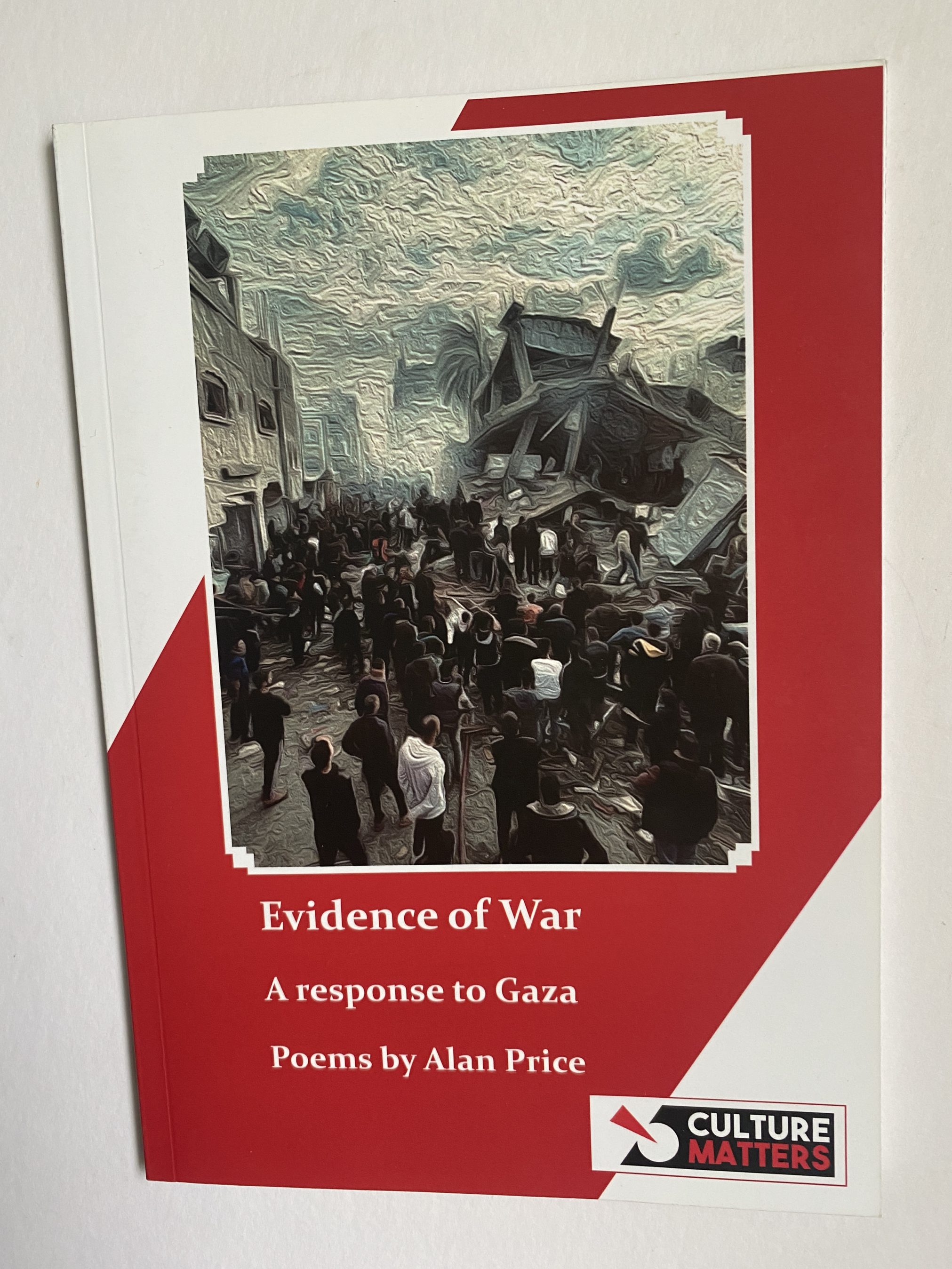
In his introduction, Price says his Gaza poem Deliverance was written when he heard the news, in February 2025, that Donald Trump and Benjamin Netanyahu had concocted a real estate plan for the rebuilding of Gaza. ‘For me the creation of a “Riviera of the Middle East” was a disturbing idea. I thought Deliverance would be a one-off poem for Gaza, but when a state of famine was officially declared and midsummer brought daily TV and radio accounts of the terrible conditions people were enduring. then I began to write a series of responses to the war.’ he says.
The result is a collection of 17 poems. His aim, not to accuse or criticise the main protagonists or their powerful allies – or even mention them by name, but to ‘try and reach out and use words to empathise, as a very distant observer, with the cruel plight of civilians being systematically starved and bombed’.
In his principle poem Deliverance the residents of ‘Hotel Humane’ are protected form the disturbing scenes outside:
‘You have enough to eat and drink and watch screens. /Still, these complaints. What’s the cause of your gripe?/ Oh, the real view is disturbing. No matter. Our concern. /We will draw down the blinds on shattered windows. /At Hotel Humane discretion for the few still matters.’
I enjoyed this collection, if that’s the right sentiment, especially as I found each of the poems always contains especially memorable lines. In Agricultural Hub, for example, where a ‘starvation machine thinks beforehand, bombing orchards, greenhouse, farmlands and fisheries…’ a Commander responsible for this poisonous destruction ‘breakfasted on bread, coffee and anger’. Later in The Dogs of War a conversation ensues between two dogs – a pompous, upright Military Dog, who denies any wrongdoing, and a local Starving Dog – forced to eat whatever or whoever it finds in the street. It’s no longer dog eat dog: ‘Humans taste better…’, the Starving Dog admits:.‘…searching for a corpse is becoming more dangerous. A dog can’t survive in Gaza’.
Later in Peace Plan the people are told ‘We have our best intentions at heart … Rule yourselves far away from us/imagining an end to fear.’ While in his final poem Renewal the poet cites Auden’s view that the best way to see a ruined city was either through the eye of a crow or a camera. Here ‘King Drone’, with its camera is constantly watching, ready to: ‘bomb the victims who may have been looking skywards at the wrong time, in the wrong place, for the wrong saviour.’
I found this collection deeply moving but also humorous and empathetic. I enjoyed the brevity of the poems – the messages more succinct. I found myself not just re-reading specific poems, but running through all 17 again at a more thoughtful pace. It is tempting to point out the wrongdoers, their idiotic presentiments and their crass ideas, but when you’ve seen the TV footage from afar, the secret filming, the reportage – as we all have: in Evidence of War you stand alongside the poet witnessing, first hand, the harrowing daily life and death that is Gaza.

Alan Price: Liverpool born, he is a poet, short story writer, film critic and blogger. His TV film A Box of Swan was broadcast on BBC 2. He has two short story collections The Other Side of the Mirror and The Illiterate Ghost. His debut collection of poetry Outfoxing Hyenas was published in 2012. His 2022 collection The Cinephile Poems (The High Window) received a multimedia presentation at the BFI. His latest collection Unknown Woman & Other Attachments (Caparison) was issued in 2024.
Evidence of War – A response to Gaza is published by Culture Matters (2026)